
Lloyds Banking Group and Visa have completed a live trial using stablecoins to settle cross-border payment obligations between the UK and the US.
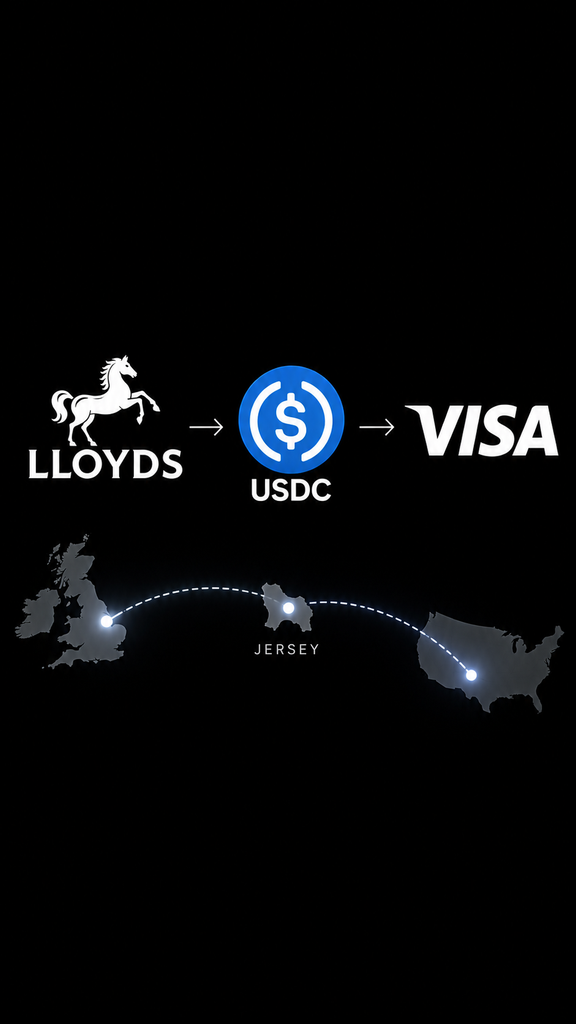
For seven days, Lloyds used USDC to settle $750,000 of payment obligations with Visa in the United States.
This wasn’t a theoretical blockchain test. Real money was used, with the USDC purchased through UK-regulated digital asset exchange Archax and transferred to Visa as part of the settlement process.
And funds reached Visa in under an hour, including, over the weekend.
And there is an interesting Jersey connection.
The settlement volume was booked through Lloyds Corporate Markets’ Jersey branch, putting Jersey directly into a real-world example of how major financial institutions are beginning to use stablecoins for international settlement.
This wasn’t about a customer paying for their coffee in crypto. It was about the infrastructure behind payments. A major financial institution settling an obligation with another global payments business using digital money.
That’s where stablecoins become particularly interesting.
Faster settlement can mean less capital sitting idle waiting for transactions to complete, better visibility over where money is and greater flexibility for treasury teams managing liquidity across borders.
The trial also looked beyond a single blockchain. Lloyds operated its own node on the Canton Network while Visa supported settlement on a separate public blockchain, testing how private and public blockchain infrastructure can work together.
The future of finance doesn’t necessarily require banks to disappear. It may simply require banking infrastructure to become faster, interoperable and available around the clock. And there are signs that stablecoins are already moving beyond experiments.
Visa recently reported that around 17% of the transaction volume on its stablecoin-linked cards so far this financial year has come from business and commercial card programmes. Visa now has more than 160 stablecoin-linked card programmes globally.
Stablecoins are increasingly being used not just as something to trade, but as infrastructure for moving, settling and spending money.
When Lloyds and Visa are settling real obligations using USDC, and businesses are increasingly using stablecoin-linked payment products, we’re no longer just talking about what the future of payments might look like. We are experiencing it