
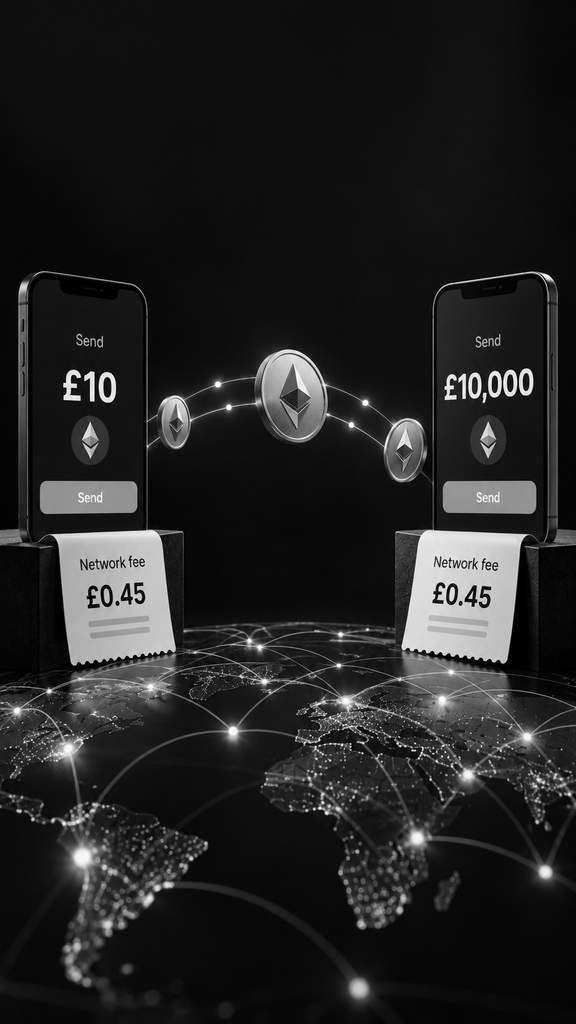
You send £10 worth of crypto. Then you send £10,000. You might expect the second transaction to cost considerably more. But on a blockchain, that isn’t necessarily how it works.
When you pay a network fee, you’re generally not paying a percentage of the value you’re sending. You’re paying for the network resources required to process, verify and record your transaction.
On Ethereum, these fees are known as “gas”.
A simple transfer requires a certain amount of computational work. More complicated transactions, such as interacting with a smart contract or making a token swap, require more.
That means moving £100 and £100,000 using the same type of transaction can require essentially the same amount of computational work.
The amount being transferred isn’t necessarily what determines the fee. So why do fees sometimes suddenly become expensive? Its because of demand.
Blockchains only have a certain amount of capacity available at any given time. When lots of people want to use the network simultaneously, demand for that space increases and fees can rise. When the network is quieter, they can fall again.
Different blockchains also have different approaches to transaction costs, which is why sending an asset using Ethereum can cost something very different from using another network such as Solana.
It’s a very different way of thinking about the cost of moving money.
When you pay a blockchain fee, you’re not really paying to move £100 or £100,000. You’re paying the network to process an instruction. The value being moved and the cost of moving it are two very different things.